
Multi-Level Decks Colorado Springs
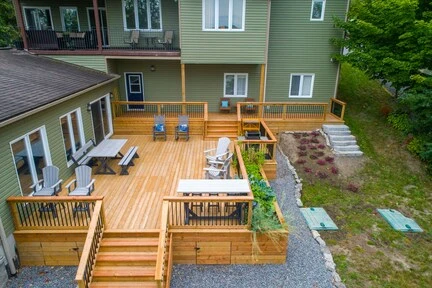
Flat backyard, sloped lot, or just want to make the most of every inch of outdoor space — a multi-level deck turns awkward terrain into a fully usable, beautifully zoned outdoor living area. Instead of one flat platform, your deck is designed in tiers that follow your yard’s natural grade, creating distinct spaces for dining, lounging, grilling, and entertaining — all connected by custom stairs and seamless transitions.
Custom Multi-Level Decks for Colorado Springs Homes
No two backyards are the same, and a multi-level deck shouldn’t be a generic stacked design pulled off a shelf. We start by mapping your yard’s elevation changes, then design levels that follow the terrain rather than fighting it — connected with custom stairs, railings, and transitions that feel intentional, not patched together. Every level is built to the same structural standards as a single-level deck, just engineered to work together as one cohesive space.
What Is a Multi-Level Deck?
A multi-level deck is two or more connected deck areas positioned at different elevations — an upper deck, a lower deck, and the stairs or landing that ties them together. It’s a useful distinction to make: a multi-level deck doesn’t necessarily mean a full second-story structure. It can just as easily mean a modest elevation change that creates two distinct zones on an otherwise flat lot, or a design that steps down a sloped backyard in stages.
Benefits of a Multi-Level Deck
Make Better Use of Sloped Yards
Colorado Springs’ Front Range lots often come with real elevation changes. A multi-level deck works with that slope instead of requiring expensive grading or fighting the terrain to force one flat platform.
Create Separate Outdoor Living Areas
A common layout puts dining and an outdoor kitchen on the upper level, closest to the house, with a lounge area or fire pit on the lower level — two distinct spaces that still feel like one connected outdoor room.
Improve Backyard Flow
A well-designed multi-level deck creates a natural path: home to upper deck, upper deck to stairs, stairs to lower deck, lower deck to the rest of the yard — instead of one abrupt drop from the house straight into the grass.
Add More Usable Outdoor Space
More zones mean more of your backyard is actually usable at once — entertaining, dining, and relaxing can all happen simultaneously instead of competing for the same flat footprint.
Multi-Level Deck Design Options
Two-Level Decks
the most common layout: an upper deck and a lower deck connected by stairs, each set up for a different use.
Tiered Decks for Sloped Yards
a stepped design that follows the natural grade of a hillside property, integrating with the landscape rather than requiring major regrading.
Elevated Multi-Level Decks
for homes with a walkout basement or significant grade drop, built with proper structural posts, stairs, and guardrails for the height involved.
Multi-Level Deck With Pergola
adding a covered section over one level creates shade and a defined “room” within the larger space.
Multi-Level Deck With Built-In Features
benches, privacy screens, lighting, planters, an outdoor kitchen, or a fire feature can all be built into specific levels as part of the original design.
Choose the Right Material for Your Multi-Level Deck
Composite decking is the most common choice for multi-level builds in Colorado Springs — lower maintenance, consistent appearance across every level, and built to hold up to our UV exposure and freeze-thaw cycles. If you want the details, our Custom Composite Decks page covers the material in depth.
Wood decking remains a solid option for homeowners who want the natural look and are comfortable with the maintenance that comes with it.
Which one fits best depends on your budget, how much upkeep you want to take on, sun exposure across the different levels, and how you plan to use the space day to day.
Custom Stairs and Railings for Multi-Level Decks
Stairs and railings aren’t an afterthought on a multi-level deck — they’re a core part of the design, since every level transition depends on them. We plan stair placement, landing size, and railing style as part of the overall layout from day one, not bolted on once the platforms are already built.
For railing style, take a look at our Glass Deck Railing and Cable and Steel Panel Railing options — both work well on multi-level builds where keeping sightlines open between levels matters.
Multi-Level Deck Safety and Building Requirements
Multi-level decks involve more structural planning than a single flat platform — proper footings, guardrails at the right locations, handrails on stairs, and a secure connection back to your home all need to be accounted for. Requirements can vary depending on your property, the deck’s height and design, and applicable local building regulations, so we plan around what’s specific to your project rather than assuming one standard applies to every build.
Transform an Existing Deck Into a Multi-Level Outdoor Space
You don’t need to start from scratch to get a multi-level layout. Adding a lower-level platform off an existing single-level deck, extending the footprint down a slope, or replacing an outdated deck with a properly zoned multi-level design are all common projects. Before any of that happens, we evaluate the existing structure — you shouldn’t assume current framing can automatically support an expanded or modified design, and we’ll tell you plainly if it can’t.
Our Multi-Level Deck Building Process
1. Site Evaluation We assess your yard’s slope, elevation changes, existing structures, drainage, and access before anything is designed.
2. Custom Design Number of levels, dimensions, stairs, railings, seating, and any features like a pergola or lighting are planned around your yard and your goals.
3. Material Selection Composite or wood, railing style, finish, and accessories are chosen to work together across every level.
4. Structural Construction Footings, posts, beams, joists, and framing go in first — the part you won’t see, but the part that determines how the finished deck performs for years.
5. Stairs and Railings Level connections, guardrails, and handrails are built to tie the whole structure together safely and cleanly.
6. Final Finishing Fascia, lighting, and any built-in features are completed, followed by a full walkthrough with you.
How Much Does a Multi-Level Deck Cost in Colorado Springs?
Cost depends on total square footage, number of levels, deck height, how much the site slopes, structural complexity, footings, stairs, railing choice, material (composite vs. wood), any built-in features or pergola, lighting, and whether an existing deck needs to be removed first. Rather than estimate a number that won’t match your actual project, request a project-specific estimate from CS Deck Experts based on your property and design.
FAQs
What is a multi-level deck?
Two or more connected deck areas positioned at different elevations, typically joined by stairs or a landing.
Are multi-level decks good for sloped yards?
Yes — they’re often the best solution for sloped properties, since the design can follow the elevation change instead of trying to force one large flat platform onto uneven terrain.
Can a multi-level deck be built on an existing deck?
Potentially, but the existing framing and structural condition need to be evaluated first — we don’t assume it’s reusable without checking.
How many levels can a deck have?
It depends on your property, design goals, structural requirements, and budget — there’s no fixed universal number. Most residential multi-level decks land at two or three levels.
Are multi-level decks more expensive than single-level decks?
Usually, yes — the added framing, stairs, railings, footings, and structural work increase complexity. Actual cost is always project-specific.
Can I add stairs between each deck level?
Yes — stair and landing design is planned as part of the overall layout, not added on afterward.
Can I use composite decking for a multi-level deck?
Yes, as long as the selected product and construction system are appropriate for the specific design and levels involved.
Can a multi-level deck include a pergola?
Yes, depending on the design and structural requirements for that section of the deck.
Check our other important services such as Custom Composite Decks and Steel Deck Framing.
We build custom multi-level decks throughout Colorado Springs and surrounding neighborhoods — see all areas we serve.
Let’s start building your dream project today! Get a Free Quote